[1]:
import quanguru as qg
import numpy as np
import matplotlib.pyplot as plt
import platform
22 - Digital quantum simulation protocol for Heisenberg model#
This tutorial builds a digital protocol that approximates the isotropic Heisenberg interaction using exchange-type couplings and local basis rotations. We compare the analog Heisenberg model (target) with Digital exchange protocol (approximation via Trotterization).
Heisenberg vs Exchange Interactions#
Heisenberg model (isotropic):
Exchange backbone:
We digitally synthesize the full Heisenberg term by combining XY couplings with basis rotations:
Conjugation with rotations maps XY → Z components
Sequence XY + rotated-XY along x and y axes reproduces x, y, z parts
[2]:
# parameters for the Hamiltonian
numOfQubits = 2
freequency = 0
freeOperator = qg.Jz
couplingStrength = 1
We create two systems:
nQubExchange: exchange-only system for the digital protocol
nQubHeisenberg: analog target with full Heisenberg coupling
[3]:
nQubExchange = numOfQubits * qg.Qubit(frequency=freequency, operator=freeOperator)
nQubHeisenberg = numOfQubits * qg.Qubit(frequency=freequency, operator=freeOperator)
Exchange system: add \(\sigma_{x}\sigma_{x}\) and \(\sigma_{y}\sigma_{y}\) for neighboring pairs with frequency=0 (will be activated during protocol steps).
[4]:
exchangeQubs = list(nQubExchange.subSys.values())
for ind in range(numOfQubits-1):
    es = [exchangeQubs[ind], exchangeQubs[ind+1]]
    nQubExchange.createTerm(operator=[qg.sigmax, qg.sigmax], frequency=0, qSystem=es)
    nQubExchange.createTerm(operator=[qg.sigmay, qg.sigmay], frequency=0, qSystem=es)
Heisenberg system: add \(\sigma_{x}\sigma_{x}\), \(\sigma_{y}\sigma_{y}\), \(\sigma_{z}\sigma_{z}\) for neighboring pairs with frequency=1.
This yields a clean separation between the digital building blocks (XY) and the target (XYZ).
[5]:
HeisenbergQubs = list(nQubHeisenberg.subSys.values())
for ind in range(numOfQubits-1):
    hs = [HeisenbergQubs[ind], HeisenbergQubs[ind+1]]
    nQubHeisenberg.createTerm(operator=[qg.sigmax, qg.sigmax], frequency=couplingStrength, qSystem=hs)
    nQubHeisenberg.createTerm(operator=[qg.sigmay, qg.sigmay], frequency=couplingStrength, qSystem=hs)
    nQubHeisenberg.createTerm(operator=[qg.sigmaz, qg.sigmaz], frequency=couplingStrength, qSystem=hs)
We construct a qProtocol composed of:
s1: free evolution step (here the on-site terms are 0 → identity; keeps timing structure)s2: an exchange step that activates pairs of XY couplings at frequency J/2xRots: global ±π/2 rotations around xyRots: global ±π/2 rotations around y
The protocol sequence (one Trotter step):
[s1, s2, xRots(+), s2, xRots(-), yRots(+), s2, yRots(-)]
s2 implements XY
Conjugation by x-rotations maps XY components to include Z contributions
Conjugation by y-rotations similarly completes the isotropic combination
This approximates the Heisenberg model.
[6]:
s1 = qg.freeEvolution(superSys=nQubExchange)

s2 = qg.qProtocol(superSys=nQubExchange)
exchangeCouplings = list(nQubExchange.terms.values())
ind = 0
while ind in range(len(exchangeCouplings)):
    u1 = qg.freeEvolution(superSys=nQubExchange)
    u1.createUpdate(system=[exchangeCouplings[ind], exchangeCouplings[ind+1]], key='frequency', value=couplingStrength/2)
    u1.createUpdate(system=exchangeQubs, key='frequency', value=0)
    s2.addStep(u1)
    ind += 2

xRots = [qg.xGate(system=exchangeQubs, angle=np.pi/2, rotationAxis='x'),
         qg.xGate(system=exchangeQubs, angle=-np.pi/2, rotationAxis='x')]
yRots = [qg.xGate(system=exchangeQubs, angle=np.pi/2, rotationAxis='y'),
         qg.xGate(system=exchangeQubs, angle=-np.pi/2, rotationAxis='y')]

protocol = qg.qProtocol(superSys=nQubExchange, steps=[s1,s2,xRots[0],s2,xRots[1],yRots[0],s2,yRots[1]])
We run a Simulation with two subsystems in parallel:
Digital: nQubExchange with the protocol
Analog: nQubHeisenberg
We compute the following metrics:
State fidelity between digital and analog: \(\mathcal{F}(\psi_{dig}, \psi_{Heis}) = |\langle \psi_{dig}|\psi_{Heis}\rangle|^2\)
Unitary distance (preCompute): spectral norm of difference between protocol unitary powers
State error (preCompute/postCompute): norms and fidelities from initial/final states
Expectation values: composite \(\sigma_z\) on each subsystem
[7]:
stepSizes = [0.01*(i+1) for i in range(50)]
freqValues = [0.01*(i+1) for i in range(100)]
totalSimTimeV = 5*2*np.pi

def preCompute(qsim):
    proList = qsim.qEvolutions
    pro1 = (proList[0].unitary()**qsim.stepCount)
    pro2 = (proList[1].unitary()**qsim.stepCount)
    uDiff = pro1 - pro2
    qsim.qRes.singleResult = 'uDiff', qg.spectralNorm(uDiff)
    qsim.qRes.singleResult = 'sErr', qg.norm(uDiff @ proList[0].initialState)
    qsim.qRes.singleResult = 'sFidStart', qg.fidelityPure(pro1@proList[0].initialState, pro2@proList[1].initialState)

def postCompute(qsim):
    proList = qsim.qEvolutions
    qsim.qRes.singleResult = 'sFidEnd', qg.fidelityPure(proList[0].currentState, proList[1].currentState)

sigmaZ = qg.compositeOp(qg.sigmaz(), 2**(numOfQubits-1))
def compute(qsim, args):
    res = qsim.qRes
    res.singleResult = 'state fidelity', qg.fidelityPure(args[0], args[1])
    for key, _ in qsim.subSys.items():
        res.singleResult = [key.name.name+'Exp', qg.expectation(sigmaZ, key.currentState)]

simulation = qg.Simulation()
simulation.initialStateSystem = nQubHeisenberg
simulation.initialState = [0 if x < 1 else 1 for x in range(numOfQubits)]
simulation.delStates = True

simulation.addSubSys(nQubExchange, protocol)
simulation.addSubSys(nQubHeisenberg)

simulation.compute = compute
simulation.postCompute = postCompute
simulation.preCompute = preCompute
simulation.totalTime = totalSimTimeV
simulation.stepSize = (stepSizes[0]+0.05)*2*np.pi

# stepSizeSweep = simulation.Sweep.createSweep(system=simulation, sweepKey='stepSize', sweepList=stepSizes)
freqSweep = simulation.Sweep.createSweep(system=[*exchangeQubs, *HeisenbergQubs], sweepKey='frequency', sweepList=freqValues)
IMPORTANT NOTE FOR WINDOWS USERS : MULTI-PROCESSING (p=True) DOES NOT WORK WITH NOTEBOOK
You can use a python script, but you will need to make sure that the critical parts of the code are under if __name__ == "__main__": We are going to add further tutorials for this later.
[8]:
simulation.run(p=(platform.system() != 'Windows'))
Starting sequential sweep with 100 parameter combinations...
Simulation Start:       2025-11-30 20:59:01
[████████████████████████████████████████] 100.0% | Est. Finish: 2025-11-30 20:59:09
Simulation completed in 00h 00m 07s
[8]:
[]
[9]:
res = simulation.resultsDict
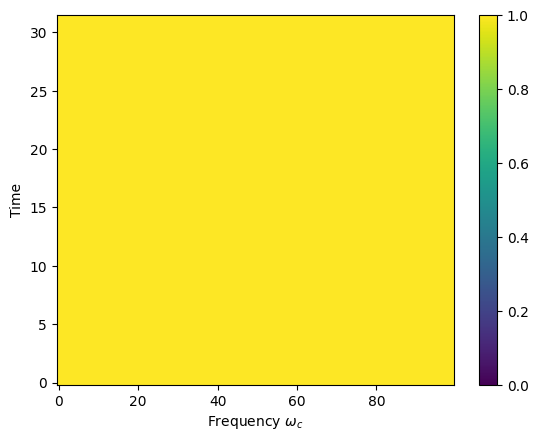
We report the fidelity between the digital protocol and the analog Heisenberg model:
Start fidelity: \(\mathcal{F}_{start} = |\langle \psi_{dig}^{(0)} | \psi_{Heis}^{(0)} \rangle|^2\)
End fidelity: \(\mathcal{F}_{end} = |\langle \psi_{dig}^{(T)} | \psi_{Heis}^{(T)} \rangle|^2\)
These represent how close the protocol’s unitary is to the target at the beginning and after the full evolution.
High fidelity across cavity frequency values indicate good digital approximation of Heisenberg from our Trotterisation protocol.
[17]:
print("Start fidelity:", res['sFidStart'][ind], " | End fidelity:", res['sFidEnd'][ind])

Y, X = np.meshgrid(simulation.timeList, [i for i in range(len(freqSweep.sweepList))])

plt.pcolormesh(X, Y, res['state fidelity'], vmin=0, vmax=1)
plt.colorbar()

plt.xlabel("Frequency $\omega_{c}$")
plt.ylabel("Time")
Start fidelity: 0.9999999999999134 | End fidelity: 0.9999999999999103
[17]:
Text(0, 0.5, 'Time')